Careço de ti, meu anjo,
Careço do teu amor,
Como da gota d'orvalho
Carece no prado a flor.
Gonçalves Dias
segunda-feira, janeiro 29, 2007

What a birth was there!
A Kiss
Thomas Hardy
By a wall the stranger now calls his,
Was born of old a particular kiss,
Without forethought in its genesis;
Which in a trice took wing on the air.
And where that spot is nothing shows:
There ivy calmly grows,
And no one knows
What a birth was there!
That kiss is gone where none can tell -
Not even those who felt its spell:
It cannot have died; that know we well.
Somewhere it pursues its flight,
One of a long procession of sounds
Travelling aethereal rounds
Far from earth's bounds
In the infinite.
Thomas Hardy
By a wall the stranger now calls his,
Was born of old a particular kiss,
Without forethought in its genesis;
Which in a trice took wing on the air.
And where that spot is nothing shows:
There ivy calmly grows,
And no one knows
What a birth was there!
That kiss is gone where none can tell -
Not even those who felt its spell:
It cannot have died; that know we well.
Somewhere it pursues its flight,
One of a long procession of sounds
Travelling aethereal rounds
Far from earth's bounds
In the infinite.
domingo, janeiro 28, 2007
#74 - O Anjo Azul

O Anjo Azul
Der Blaue Engel
Alemanha, 1930
Dir.: Josef Von Sternberg
"Josef von Sternberg's use of stark, hyperbolic imagery to symbolize moral degradation is derived from the German expressionist cinema. Note the two scenes where Professor Rath crows like a rooster: one, an attempt at humor, the other, a cry of despair. Both scenes suggest his subservience and debasement at the hands of the seductress. Most of the scenes occur at night and in cabarets, emphasizing the dark, sordidness of his situation. From a historical perspective, The Blue Angel was filmed during the Weimar Republic when the German government, caught in a stranglehold over war reparations, was on the verge of collapse. The film echoes the cynicism and hopelessness of the times. As a result, the story is extremely caustic and unforgiving: the desperate voice of a country in turmoil." Strictly Film School
#75 - Os Melhores Anos de Nossas Vidas

Os Melhores Anos de Nossas Vidas
The Best Years of Our Lives
EUA, 1946
Dir.: William Wyler
"It is seldom that there comes a motion picture which can be wholly and enthusiastically endorsed not only as superlative entertainment but as food for quiet and humanizing thought. Yet such a one opened at the Astor last evening. It is "The Best Years of Our Lives." Having to do with a subject of large moment—the veteran home from war—and cut, as it were, from the heart-wood of contemporary American life, this film from the Samuel Goldwyn studio does a great deal more, even, than the above. It gives off a warm glow of affection for everyday, down-to-earth folks. "The Best Years of Our Lives" catches the drama of veterans returning home from war as no film—or play or novel that we've yet heard of—has managed to do. In telling the stories of three veterans who come back to the same home town—one a midde-aged sergeant, one an air officer and one a sailor who has lost both hands—it fully reflects the delicate tensions, the deep anxieties and the gnawing despairs that surely have been experienced by most such fellows who have been through the same routine. It visions the overflowing humors and the curious pathos of such returns, and it honestly and sensitively images the terrible loneliness of the man who has been hurt—hurt not only physically but in the recesses of his self-esteem. (...) And by demonstrating frankly and openly the psychological blocks and the physical realities that go with prosthetic devices they have done a noble public service of great need." Bosley Crowther
#76 - A Bela e a Fera

A Bela e a Fera
La Belle et la Bête
França, 1946
Dir.: Jean Cocteau
"Si l’œuvre est une adaptation du conte que Madame Leprince de Beaumont avait écrit en 1757, Cocteau en a fait une œuvre poétique inspirée du surréalisme. Enchantement pour l’esprit, cette œuvre est aussi un enchantement pour l’œil : chaque séquence du film est l’occasion d’une trouvaille visuelle admirable.Du corridor éclairé par des bras-torches jaillissant tour à tour du mur jusqu’au mystérieux temple de Diane, tout est fantasme poétique. Et c’est sans doute ce qui éloigne le film de toute mièvrerie... Cocteau tient d’autre part à composer avec le hasard et l’imprévu du tournage. Ainsi, s’il attache une grande attention à la disposition des scènes et au trucage, il en accorde en revanche très peu aux raccords : peu importe si la luminosité change entre deux prises ou si un objet n’est plus exactement à la même place, l’incongruité de l’éclairage contribuera au merveilleux et à l’effet de surnaturel recherchés. Pourquoi peut-on revoir La Belle et la Bête un nombre considérable de fois sans s’en lasser ? Peut-être parce que comme dans Jekyll et Hyde ou dans Le petit prince, on fait à tout âge son miel de l’histoire qui nous est contée. Emerveillé par l’histoire quand on est enfant, méditant sur cette histoire d’amour et sur la différence quand on est adolescent, on y voit plus tard un jeu sur l’humanité et l’animalité qui sont les deux pôles de tension qui charpentent le film. (...) Enfin, l’on retrouve comme dans Orphée le thème du miroir : au-delà du miroir de l’âme, celui offert par la Bête à sa captive joue aussi le rôle du passage entre les deux mondes, entre la maison du père mourant de la Belle et le château de la Bête. Là où la Belle n’est pas, on se meurt... Stendhal avait donc raison, la beauté est bien une promesse de bonheur." Critiques Ordinaires
#77 - Dúvida

Dúvida
The Suspect
EUA, 1944
Dir.: Robert Siodmak
"Siodmak skillfully conveys the claustrophobia and repression of Edwardian England in this psychological drama—inspired by the sensational 1910 Crippen case—about a likeable, kindly manager of a tobacco shop who murders his shrewish, domineering wife when she threatens his growing friendship with a beautiful young woman. As the desperate protagonist, Laughton gives one of his most deeply felt performances and creates one of his most memorable characters: a deeply lonely man whose desire for happiness drives him to extremes but whose conscience cannot be so easily silenced." FilmRadar
sábado, janeiro 27, 2007
#78 - Um Tiro na Noite

Um Tiro na Noite
Blow Out
EUA, 1981
Dir.: Brian De Palma
Blow Out
EUA, 1981
Dir.: Brian De Palma
"[It is] a movie which continues [De Palma's] practice of making cross-references to other movies, other directors, and actual historical events, and which nevertheless is his best and most original work. (...) In Blow Out there are such Hitchcock hallmarks as a shower scene (played this time for laughs rather than for the chills of Dressed to Kill), several grisly murders in unexpected surroundings, violence in public places, and a chase through Philadelphia on the anniversary of the ringing of the Liberty Bell. (...) Best of all, this movie is inhabited by a real cinematic intelligence. The audience isn't condescended to. In sequences like the one in which Travolta reconstructs a film and sound record of the accident, we're challenged and stimulated: We share the excitement of figuring out how things develop and unfold, when so often the movies only need us as passive witnesses." Roger Ebert
#79 - São Jerônimo

São Jerônimo
Brasil, 1999
Dir.: Júlio Bressane
Brasil, 1999
Dir.: Júlio Bressane
.
"Não é toda hora que um cineasta com 30 anos de trabalho consistente busca caminhos longe de suas estradas usuais. Mas é o que vemos em São Jerônimo. Com esse filme, Júlio Bressane renova seu vocabulário, instaura uma nova gramática longe das antigas figuras (tornadas clichês) que habitavam seus últimos filmes. São Jerônimo é um salto: caminho da santidade e humildade de Jerônimo, o santo, que restaura o vigor de um cinema, o de Bressane, que já estava deixando de ter seu interesse. É a humildade uma lição para o enfant gaté do cinema brasileiro: das imagens desnecessárias e um tanto infantis de Miramar, nada vemos. São Jerônimo é composto de grandes blocos de planos fixos, de uma simplicidade que faz brilhar os olhos, de um mínimo representacional (nada além de vestes, paisagens e certas figuras mentais do santo) que é adequadamente escolhido para representar um homem simples e de hábitos poucos. (...) "Cinema é a música da luz", Bressane costuma citar. E essa música é transparente em São Jerônimo. A luz não é objeto para jogo. Ela trabalha para uma nova beleza na obra de Júlio Bressane (...), beleza que vem diretamente da iluminação, onde a duração dos planos deixa tanto melhor nós observarmos e compreendermos o tamanho de tanta fascinação diante da luz. Beleza simples, que se encontra com a simplicidade da direção." Ruy Gardnier
#80 - Meu Tio

Meu Tio
Mon Oncle
França, 1958
Dir.: Jacques Tati
Mon Oncle
França, 1958
Dir.: Jacques Tati
"Mon Oncle features some of Tati’s best visual jokes - such as the house-proud wife constantly switching on and off her ornamental garden fountain whenever a guest arrives, and the high jinks at the plastics factory, where Hulot manages to get a machine to produce plastic pipes in the shape of strings of sausages. As in many of Tati’s films, contrasts are made between children (whom Tati most closely seems to identify with) an adults (who are usually portrayed as idiots). The artificial pomposity of the Arpels is ridiculed whereas the natural rebelliousness of the young boys is glorified. This suggests a parable of innocence in which the children, who have yet to succumb to the charms of technology are shown to be wiser than adults who, for reasons of greed or vanity, have made technology their god. That Hulot seems to get on better with children (and stray dogs) only serves to underline this simple message. Not only is Mon Oncle an a greatly entertaining piece of cinema, it is also frighteningly prophetic. Forty years on, the charming world inhabited by Monsieur Hulot has all but disappeared and, to a greater or lesser extent, we have all ended up slaves of technology, much of which is of dubious benefit. To this audience, watching Mon Oncle can be a poignant experience. As we laugh at the exploits of Monsieur Hulot and his inability to adapt to a changing world, we see something of ourselves and perhaps nurture a secret yearning to return to a simpler, less technologically orientated way of life." James Travers
#81 - Sangue e Areia

Sangue e Areia
Blood and Sand
EUA, 1941
Dir.: Rouben Mamoulian
"One of the great colour films (with Mamoulian taking the inspiration for his lush visuals from Spanish masters like Goya, Velasquez and El Greco), this is melodramatic romance of the first order. The story is hardly a stunner, taken from Ibañez and telling of a young man's rags-to-riches rise as a matador, only to fall under the spell of Hayworth's aristocratic temptress, who lures him away from virginal childhood sweetheart Darnell. What makes the film so enjoyable is the sheer elegance of the execution, with Mamoulian's sense of rhythm, the rich Technicolor, and Richard Day's sets conjuring up an imaginary Spain of the heart, poignant location of love in the shadows and death in the afternoon." Time Out
#82- Os Picaretas

Os Picaretas
Bowfinger
EUA, 1999
Dir.: Frank Oz
Bowfinger
EUA, 1999
Dir.: Frank Oz
"Bowfinger is one of those comedies where everything works. Where the premise is not just a hook but the starting point for a story that keeps developing and revealing new surprises. Like a lot of Steve Martin's other writing, it is also gentle and good-natured: He isn't a savage ironist or a vulgarian, and when he makes us laugh, it's usually about things that are really funny. Shell-shocked in this year of gross and grosser comedies, we can turn to Bowfinger with merciful relief." Roger Ebert
#83 - O Silêncio dos Inocentes

O Silêncio dos Inocentes
Silence of the Lambs
EUA, 1991
Dir.: Jonathan Demme
"Demme, na análise de Olavo de Carvalho, queria antes de tudo fazer de seu filme “um apólogo sobre a luta entre a inteligência humana e a astúcia diabólica” — um apólogo sobre o caminho da iniciação e do autoconhecimento. (...) Diderot, o escritor e enciclopedista, achava que “toda a verdadeira poesia é emblemática”. Se assim for, pode-se dizer que O Silêncio dos Inocentes contém, poeticamente, em cada imagem todos os emblemas da busca da individuação, da revelação, da verdade. Através da trajetória de Clarice Starlíng, Jonathan Demme evoca o itinerário dos cavaleiros medievais na procura do Santo Graal, de todos os místicos em confronto com as tentações do Mundo e do Diabo." José Carlos Monteiro
Silence of the Lambs
EUA, 1991
Dir.: Jonathan Demme
"Demme, na análise de Olavo de Carvalho, queria antes de tudo fazer de seu filme “um apólogo sobre a luta entre a inteligência humana e a astúcia diabólica” — um apólogo sobre o caminho da iniciação e do autoconhecimento. (...) Diderot, o escritor e enciclopedista, achava que “toda a verdadeira poesia é emblemática”. Se assim for, pode-se dizer que O Silêncio dos Inocentes contém, poeticamente, em cada imagem todos os emblemas da busca da individuação, da revelação, da verdade. Através da trajetória de Clarice Starlíng, Jonathan Demme evoca o itinerário dos cavaleiros medievais na procura do Santo Graal, de todos os místicos em confronto com as tentações do Mundo e do Diabo." José Carlos Monteiro
#84 - Ladrão de Alcova

Ladrão de Alcova
Trouble in Paradise
EUA, 1932
Dir.: Ernst Lubitsch
"Trouble in Paradise is the most fondly memorable—if rarely seen—Hollywood screwball comedy. Its combination of suaveness, hilarity, and sexiness has had a mighty influence. There would be no Bringing Up Baby, no The Lady Eve, no Pat and Mike, without the delicious trouble Ernst Lubitsch and screenwriter Samson Raphaelson stirred up.What’s called “The Lubitsch Touch” is, essentially, sophistication. (...) Trouble in Paradise’s teasing insight into the machinations of the heart has influenced every romantic comedy to come after it. But no other movie can match the way Gaston, Lily, and Mariette’s rendezvous make you laugh, sigh and reflect. It steals the heart of every lucky person who sees it." Armond White
Trouble in Paradise
EUA, 1932
Dir.: Ernst Lubitsch
"Trouble in Paradise is the most fondly memorable—if rarely seen—Hollywood screwball comedy. Its combination of suaveness, hilarity, and sexiness has had a mighty influence. There would be no Bringing Up Baby, no The Lady Eve, no Pat and Mike, without the delicious trouble Ernst Lubitsch and screenwriter Samson Raphaelson stirred up.What’s called “The Lubitsch Touch” is, essentially, sophistication. (...) Trouble in Paradise’s teasing insight into the machinations of the heart has influenced every romantic comedy to come after it. But no other movie can match the way Gaston, Lily, and Mariette’s rendezvous make you laugh, sigh and reflect. It steals the heart of every lucky person who sees it." Armond White
#85 - Adeus, Meninos

Adeus, Meninos
Au Revoir, Les Enfants
França, 1987
Dir.: Louis Malle
"A film that is both very perceptive about child psychology and deeply moving, Au revoir, les enfants is easily one of Louis Malles’s best films - if not his best film. Drawn from his own personal recollections of school during the war, this film tells a simple story with no clear message or morale standpoint. It relates the day-to-day experiences of children in a boarding school in a way that is more realism than nostalgia, without major incident until the final, tragic conclusion. (...) The film’s strength - and Malle’s great achievement - is in portraying the children as fully-formed adults, with an awareness (if not a full understanding) of their predicament and the ability to consciously act for good or ill. This avoids the sentimentality which weighs down many films about children and the result is a very watchable and genuinely engaging film." James Travers
Au Revoir, Les Enfants
França, 1987
Dir.: Louis Malle
"A film that is both very perceptive about child psychology and deeply moving, Au revoir, les enfants is easily one of Louis Malles’s best films - if not his best film. Drawn from his own personal recollections of school during the war, this film tells a simple story with no clear message or morale standpoint. It relates the day-to-day experiences of children in a boarding school in a way that is more realism than nostalgia, without major incident until the final, tragic conclusion. (...) The film’s strength - and Malle’s great achievement - is in portraying the children as fully-formed adults, with an awareness (if not a full understanding) of their predicament and the ability to consciously act for good or ill. This avoids the sentimentality which weighs down many films about children and the result is a very watchable and genuinely engaging film." James Travers
domingo, janeiro 21, 2007
#86 - Cinzas e Diamantes

Cinzas e Diamantes
Popiól i Diament
Polônia, 1958
Dir.: Andrzej Wajda
"If, for all its tragedy and multiple ironies, the film exhilarates, it is through the power of its artistry and because the authority of its synthetic image of the postwar Polish dilemma does indeed tell as much of the truth as could be told—as Dabrowska had said. The artistry is not confined to Cybulski’s performance or Wajda’s compression of Andrzejewski’s more leisurely novel and list of dramatic personae into a tightly knit, twenty-four-hour confrontation. It is also continually present in the deep focus of cameraman Jerzy Wojcik, which both underscores the ironies and evokes the oppressiveness of a history with whose cruelty Poles had become all too well acquainted." Paul Coates
#87 - ...E O Vento Levou

...E O Vento Levou
Gone With the Wind
EUA, 1939
Dir.: Victor Fleming
"As an example of filmmaking craft, "GWTW'' is still astonishing. (...) there is a joyous flamboyance in the visual style that is appealing in these days when so many directors have trained on the blandness of television. Consider an early shot where Scarlett and her father look out over the land, and the camera pulls back, the two figures and a tree held in black silhouette with the landscape behind them. Or the way the flames of Atlanta are framed to backdrop Scarlett's flight in the carriage. (...) [The film] will be around for years to come, a superb example of Hollywood's art and a time capsule of weathering sentimentality for a Civilization gone with the wind, all right--gone, but not forgotten." Roger Ebert
#88 - Amores de Apache

Amores de Apache
Casque D'Or
França, 1952
Dir.: Jacques Becker
"Casque d’Or demeure un film phare du cinéma français toutes époques confondues. C’est l’œuvre d’un artiste méticuleux et discrètement romantique, peintre impressionniste d’univers cloisonnés et gouvernés par des cérémonials dont la représentation à l’écran apparaît la plus naturelle qui soit. (...) Casque d’Or acquiert son aura mythique. On n’oubliera pas non plus l’utilisation bouleversante de la chanson Le Temps des cerises qui soutient habilement le ton mélancolique de l’œuvre.Sublime, on vous dit." Roy Neary
#89 - Marujo de Encomenda
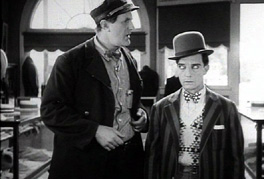
Marujo de Encomenda
Steamboat Bill, Jr.
EUA, 1928
Dir.: Charles F. Reisner
(Este filme está disponível em DVD com outro título: O Herói do Rio)
"Silent-comedy legend Buster Keaton's last independent film – and penultimate one under his exclusive control – before giving himself over to MGM, which proceeded to run his career into the ground. Steamboat Bill, Jr., from 1928, is one of the comedian's richest works. Far more elaborate than the breezy, but minor, College, this movie returned Keaton to the heights of elaborate visual comedy. Its climactic cyclone sequence is quite the most impressive and involved of the comic actor's filmography, even outdistancing the destruction of an entire train in The General. (...) Steamboat Bill, Jr. is, first and foremost, a wildly creative comedy that has as much power to impress and amuse an audience today as it did in '28." Ken Hanke
#90 - Scanners, Sua Mente Pode Destruir
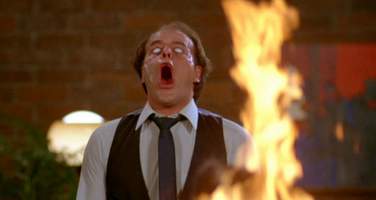
Scanners - Sua Mente Pode Destruir
Scanners
Canadá, 1981
Dir.: David Cronenberg
"On the surface, Scanners is yet another of the exploitive splatter flicks of the early 1980s that Canada was so notorious for producing. Beyond the surface, the film is a deep meditation on the state of the mind in a time of medical and technological experimentation. Like with all of Cronenberg's early efforts, this is a film that seems to be created in direct scrutiny of Canada's ever-controlling public health care system. If a single drug can nearly bring the apocalypse in Scanners, then what can happen when an entire system of state medical control makes a mistake? (...) Scanners questions many major concerns surrounding the mind, and Cronenberg executes it with some of his most intense direction." Rhett Miller
sábado, janeiro 20, 2007
#91 - A Orgia da Morte

A Orgia da Morte
Masque of the Red Death
EUA, 1964
Dir.: Roger Corman
"While often embellishing on the original story, The Masque of the Red Death remains true to the essence of Poe's work. The settings, characters and dark themes all combine to create a Gothic, surrealistic world suitable to the Red Death's machinations, and, of course, the pervading sense of horror and foreboding characteristic of a Gothic film. It is therefore unsurprising that The Masque of the Red Death is considered one of Roger Corman's greatest directorial accomplishments and the high point of the Poe Cycle. It is a brilliant film, both visually and thematically, and one that every classic horror fan would do well to watch." Julia Merriam
Assinar:
Postagens (Atom)
